How Much Downtime Can Your Business Afford? Understanding Five 9s Reliability
As businesses continue to rely on cloud-based applications, system uptime has become a critical measure of reliability and performance. Users expect applications to be available whenever they need them, making high availability an essential requirement rather than a competitive advantage.
Understanding application availability, and how cloud providers design, monitor, and maintain uptime, is key to evaluating the reliability of cloud services and the service level commitments they provide.
What is "uptime"?
Uptime refers to the percentage of time a cloud-based application remains operational and accessible during a given period, typically measured quarterly or annually. It is a key indicator of an application's reliability and availability.
Most cloud service providers define their uptime commitments through a Service Level Agreement (SLA). An SLA is a contractual agreement that specifies the minimum level of service a provider guarantees. The closer the uptime commitment is to 100%, the less downtime users can expect, resulting in greater reliability and business continuity.
What is "Five 9s" reliability?
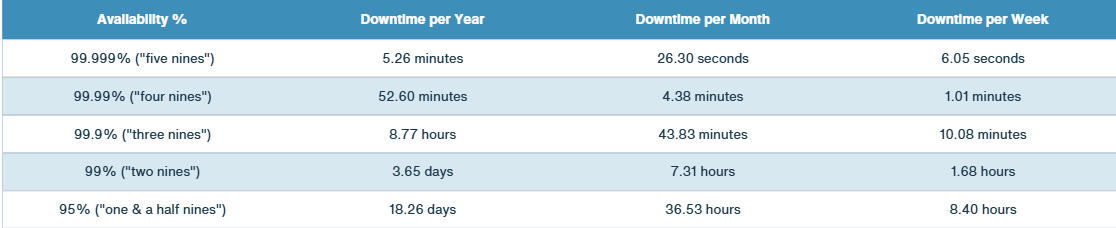
You've likely heard the term "Five 9s" thrown around by sales teams. What it actually refers to is 99.999% system availability.
To put that into perspective, running on a "Five 9s" platform means your business communications should experience fewer than 78 seconds of total downtime over an entire quarter (or roughly 5 minutes and 15 seconds a year). It is considered the gold standard of platform stability.
If a provider's SLA drops even slightly below this standard, the potential real-world impact to your schedule skyrockets:
The business cost of dropped connections
When your communication tools fail, your daily operations don't just slow down, they completely freeze. Across different sectors, a drop in service is a direct hit to your reputation and bottom line:
- Healthcare: Patients lose their lifeline to speak with local pharmacies or doctors for urgent medical inquiries.
- Manufacturing: Production lines stall when teams cannot coordinate with suppliers, maintenance crews, or logistics partners, leading to costly delays and missed production targets.
- Logistics & Transportation: Dispatchers lose contact with drivers, resulting in delayed deliveries, missed pickups, and disrupted supply chains.
- Hospitality & Travel: Hotels, airlines, and travel agencies struggle to manage reservations, customer inquiries, and last-minute itinerary changes, reducing customer satisfaction.
- Emergency Services: Communication disruptions can delay coordination between dispatchers, first responders, and support agencies during time-sensitive incidents.
- Technology & IT Services: Help desks and support teams become unreachable, increasing incident resolution times and prolonging service outages for customers.
- Education: Virtual lecture halls shut down, leaving remote classrooms and teachers entirely disconnected.
- Public Services: Citizens are cut off from accessing critical municipal utilities and local administrative hubs.
- Financial & Legal: Traders miss market execution windows, and attorneys miss court-mandated client check-ins.
- Retail & Commerce: If a customer can't get a representative on the phone, 46% of them will hang up and abandon their purchase, 35% will buy from a competitor, and 17% will leave an online complaint
5 questions to put your provider's reliability to the test
If you are vetting cloud platforms or switching to a hosted phone system, don't just take their marketing numbers at face value. Put their technical team on the spot with these five direct questions:
- Where is our data stored, and what happens if one of those regions suffers a massive power grid failure?
- How is your hosting architecture configured to handle massive, unexpected traffic spikes?
- How frequently do you run "chaos testing" (actively turning off live servers to see if backup systems deploy seamlessly)?
- What is your disaster recovery plan, and when was the last time it was updated and tested?
- Can you provide independent, third-party uptime reports verifying your SLA history?
How modern networks prevent total outages
Behind every highly reliable cloud system is a deep web of preventative engineering. The best networks avoid total failure by building their systems around four basic concepts:
- Geographic Redundancy: Hosting system operations in physically separate data centers across the country. If a localized storm knocks out power in one state, another site instantly assumes the operational workload.
- Intra-Data Center Backups: Duplicating vital hardware inside each building so that if an individual server or routing switch fails, an identical unit is already online and active in its place.
- Proactive System Monitoring: Utilizing advanced automated tools to monitor network traffic patterns and call quality, fixing minor hardware hiccups long before they trigger an actual outage.
- Rigorous Security Protocols: Maintaining top-tier digital access controls and security patches to prevent bad actors from taking the entire network offline.
The SpectrumVoIP approach to zero-interruption service
We design our hosted phone system around a simple promise: when your business needs to make a call, our dial tone is there. We've built an enterprise-grade cloud architecture specifically engineered to keep your organization connected, regardless of external circumstances.
Active-Active Server Mirroring
Our cloud PBX platform doesn't wait for a crash to start looking for backups. We run our phone system on an active-active setup, meaning call traffic is distributed dynamically across multiple cloud servers simultaneously. If a server experiences a glitch, our automated failover technology seamlessly moves your live calls to an active system without dropping the connection.
Tier-1 Carrier Redundancy
Because we operate on a multi-carrier network backbone, we aren't dependent on any single telecom giant. If an external carrier route experiences sudden lag, dropped packets, or localized outages, our intelligent routing automatically shifts outbound and inbound call traffic to alternative major carriers.
True U.S.-Based Support, Whenever You Call
System reliability isn't just about software; it's about the people standing behind it. While other providers redirect your troubleshooting calls to automated chatbots or offshore queues, SpectrumVoIP provides direct access to real, U.S.-based technicians 24/7/365 from our home office in Plano, Texas.
Keep your business connected
Your business communications are too important to trust to "best effort" service. With SpectrumVoIP, you get enterprise-grade reliability, crystal-clear voice quality, and a dedicated team of technical experts watching your back around the clock.